

History of the Freedom Tower
Honoring the many chapters of the Freedom Tower’s iconic story
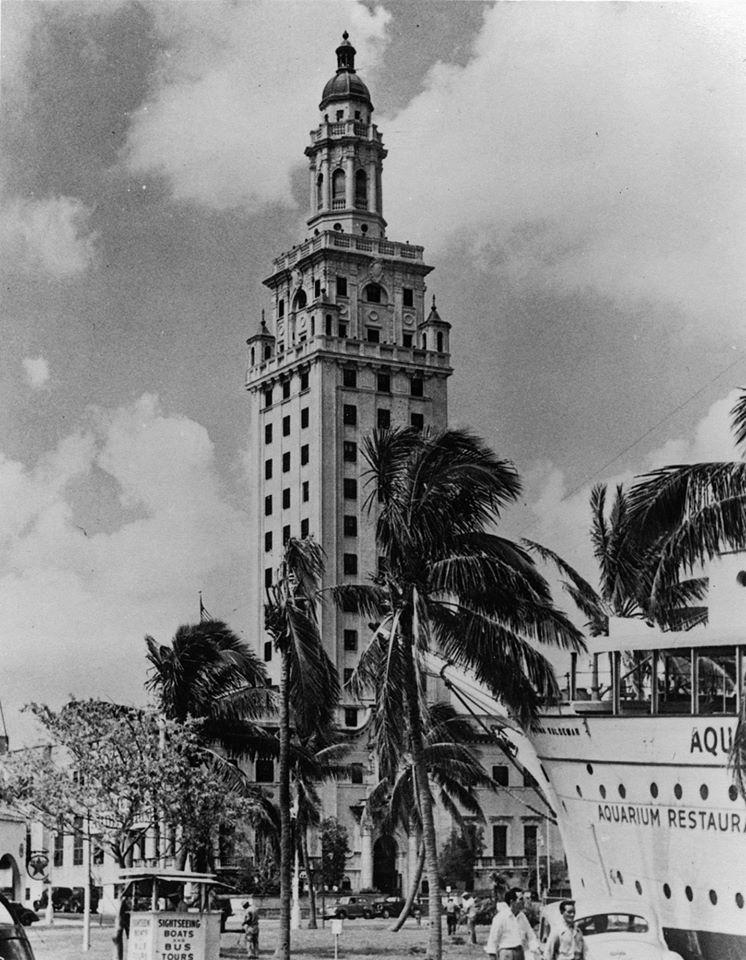
The Freedom Tower was built, like much of Miami, by an ambitious businessman and civic leader, eager to join in creating a new city. James Middleton Cox, a former Ohio congressman, governor, and presidential candidate lured to Miami in 1923 by pioneering Miami Beach developer Carl Fisher, constructed the Tower to house his newly purchased newspaper, The Miami Daily News and Metropolis (soon to become The Miami News).
Cox hired a prestigious New York architectural firm, Schultze and Weaver, responsible for luxury landmarks such as New York’s Waldorf-Astoria (1931), The Breakers Hotel in Palm Beach (1926), and the Hotel Sevilla-Biltmore in Havana (1924). The firm modeled the Miami News Tower on the Giralda bell tower of the cathedral of Seville in Spain, with an elaborate mix of Moorish and Spanish and Italian Baroque elements in the Mediterranean Revival style, a fantastical architectural mix that dominated early Miami. (Schultze and Weaver designed two other famous early Miami buildings, the Miami Biltmore Hotel in Coral Gables and the Roney Plaza Hotel in Miami Beach, also based on the Giralda.)
The home of Cox’s newspaper was no mere functional office building. It was a grand structure meant to impress, to proclaim a major institution in a striving new city—a monument to what Miami would become.
Completed in 1925, the 289-foot-high Tower (briefly the tallest building in the South) was Miami’s lodestar, so tall that ships used it to navigate. It towered over the city center on the edge of Biscayne Bay, where the terminus of the Florida East Coast Railway met the Port of Miami—the meeting point of the city’s key transport systems. The Miami News became the city’s leading paper and a flagship in the growing Cox media chain, tackling notorious gangster and Miami resident Al Capone, governmental corruption, and civil rights, and winning multiple Pulitzer Prizes. In 1935, the Wonderful Isle of Dreams (WIOD) radio station moved into the News Tower. With an affiliation to NBC, WIOD became Miami’s first radio station with a national network.
The News moved out in 1957, followed by WIOD soon after, opening the building’s next chapter. In 1962, the building became the home of the Cuban Refugee Center. At the place that Cuban exiles dubbed El Refugio (The Refuge), hundreds of thousands of Cuban refugees received financial aid, food, medical care, and crucial help in establishing a new life.
Where the News Tower had been a monument to a new city, the Freedom Tower became a landmark for a dynamic era in Miami. For Cuban refugees, it served as a symbol for American ideals of liberty and democracy. It was the entryway for a new population who would transform Miami from a Southern resort town to an international metropolis powered by Latin American immigrants—a new kind of American city.
However, when the Cuban Refugee Center Program ended in 1974, the Freedom Tower began a long period of uncertainty. As suburbanization and urban blight took a toll on Downtown Miami, the building changed hands multiple times, deemed too expensive to either develop or demolish. Though listed in the National Register of Historic Places in 1979, the empty structure was badly damaged by neglect and vandals.
The Freedom Tower was rescued in 1997 by Jorge Mas Canosa, leader of the Cuban American National Foundation, who bought the building to turn it into a monument to the Cuban American experience. Mas Canosa died just two months later, but his son Jorge Mas Santos persevered, opening the Tower in 2002 with a celebration for thousands of people, joined by Cuban American leaders and celebrities. In 2003, the Freedom Tower hosted a massive memorial to revered Cuban exile singer Celia Cruz, the “Queen of Salsa,” who lay in state at the Tower during a celebration for 200,000 people that filled Downtown Miami. In 2004, however, the Mas family sold the building to Pedro Martin, a prominent Cuban American business leader and developer, who donated it to Miami Dade College the next year.
Led by former MDC President Eduardo J. Padrón, the College conducted a thorough restoration. The Freedom Tower’s designation as a National Historic Landmark, awarded in October 2008, recognized its outstanding historical significance for its role in processing refugees fleeing to Florida during the Cuban revolution. It is now home to Miami Dade College’s prestigious cultural programs:
As Downtown has boomed with new development and major arts institutions in recent years, the Freedom Tower has again taken its rightful place as an iconic landmark in the heart of Miami.
After a two year renovation, the Freedom Tower reopened for its Centennial in 2025. Exhibitions guide visitors through the Tower’s multifaceted past, encompassing its significance as both the home of the Miami Daily News and the Cuban Refugee Center. The experience situates personal and collective journeys for freedom within a broader historical context, inviting reflection and dialogue. Through this lens, the Tower is reimagined as a modern landmark of courage, perseverance, and opportunity.
Please visit the Freedom Tower’s website to learn more.